
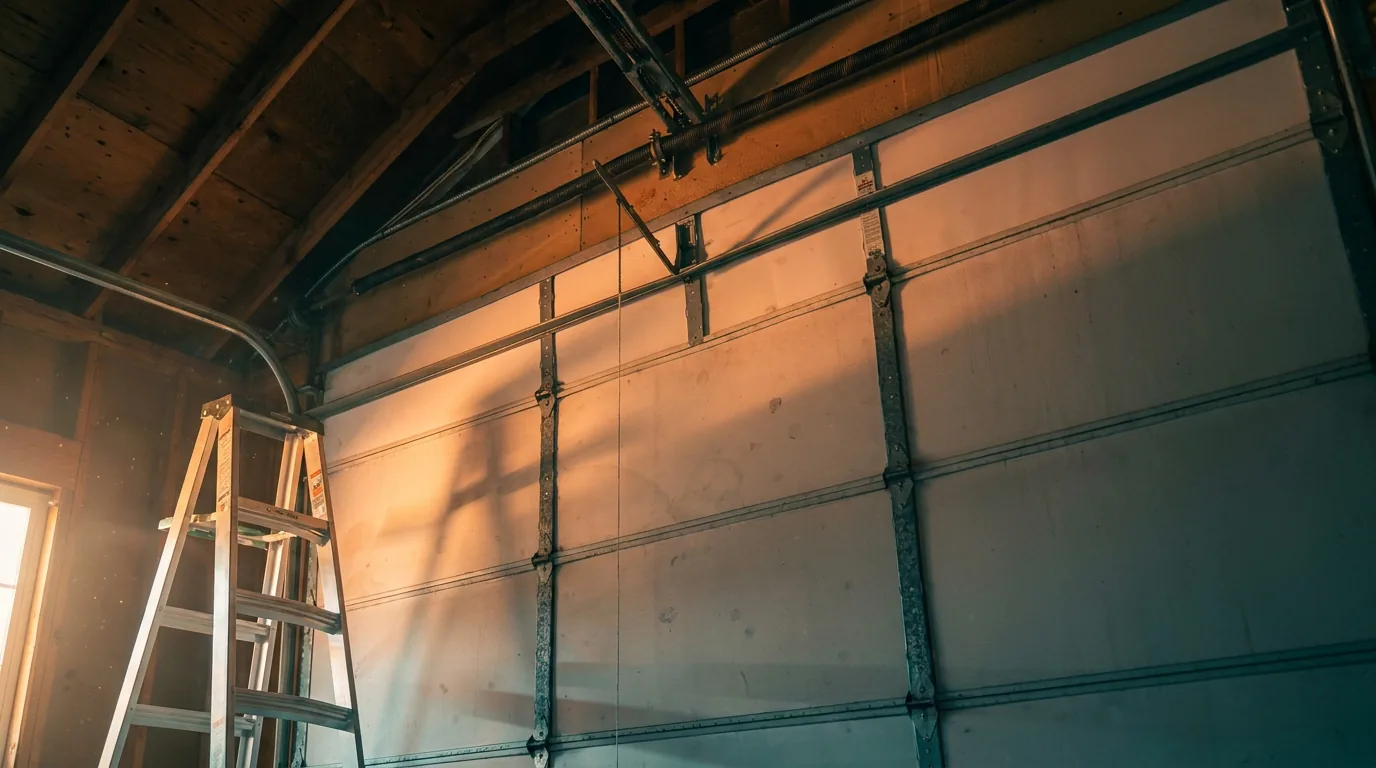
The storage rack arrived flat-packed, was assembled on the driveway on a Saturday, and was bolted into the ceiling joists by about four o'clock. At ten past four someone pressed the button to put the car away, and the top section of the door came up, turned onto its horizontal track, and met the rack with a noise the whole street heard.
It is an easy mistake in a house without a basement or much of an attic, which describes a lot of Natomas and Elk Grove, where the garage ends up as the storeroom, the gym and the workshop as well as the place the car goes. The ceiling looks empty. It is not empty. It belongs to the door.
Where the door actually goes when it opens
A standard sectional door runs straight up its vertical tracks, turns through a curve just above the opening, and then lies flat along a pair of horizontal tracks under the ceiling. When it is fully open, the whole door is hanging up there, parallel to the floor. The horizontal tracks run back from the header roughly as far as the door is tall, plus a bit, and the opener rail runs back further still.
So a seven-foot door on a standard lift uses a strip of ceiling at least seven feet deep and as wide as the door, and the opener adds its own strip down the middle. Above the opening, the torsion spring and its shaft need room too, typically around a foot of headroom between the top of the door and the ceiling on a standard install.
Everything else on the ceiling has to live outside that footprint, or the door will find it. Lights, too. A ceiling fixture that sits a few inches too low is the other thing the top section likes to meet.
The three ways to change the geometry
- Low-headroom. For garages without enough room above the opening. The track is doubled or the springs are moved to the back, so the door turns tighter. It fixes a shortage of space rather than creating any.
- High-lift. The vertical tracks are extended above the opening, so the door rises most of the way up the wall before it turns. The horizontal section is shorter and sits much closer to the ceiling, which frees the space below it. It needs a ceiling well above the top of the door to be worth doing.
- Vertical-lift. The door goes straight up and never turns at all. It needs a ceiling roughly twice the height of the door, which is why it is mostly for tall workshops and car lifts.
What a high-lift conversion actually changes
This is not a track swap. The door is now travelling a longer vertical distance before the ceiling takes any of its weight, so the whole lifting system is different.
The cable drums change to high-lift drums, which wind differently to handle the extra vertical travel. The cables get longer. The springs are recalculated for the new geometry, and sometimes replaced. The vertical tracks and their mountings go up the wall.
Get any of those wrong and the door is heavy at the top, dropping at the bottom, or throwing its cables off the drums, which is an alarming thing to watch from underneath.
Why the opener usually moves to the wall
A normal ceiling opener pulls the door along a rail by its top section. That works when the door turns near the header. On a high-lift door, the door spends most of its travel going straight up, and a trolley on a ceiling rail is pulling at the wrong angle for most of it.
The answer is a wall-mount opener, sometimes called a jackshaft. It sits on the wall beside the door and turns the torsion shaft directly, so there is no rail, no trolley and nothing hanging from the middle of the ceiling at all. That is also why they appeal to people who have no interest in high-lift: the ceiling is completely clear.
They have conditions. The door must use torsion springs on a shaft, not extension springs running along the tracks. There needs to be clear wall space at the end of the shaft, and power there.
And because the door is not held shut by a trolley on a rail, many wall-mount units pair with a sensor on the cable or an automatic lock, which is worth asking about. As a side effect, with nothing bolted to the joists, they are also very quiet in the room above.
The cheap answer, which is often the right one
Plenty of rack collisions are not solved by changing the door. They are solved by moving the rack eighteen inches.
Open the door fully with the opener, stand underneath with a tape measure, and pencil a line on the ceiling around the footprint of the door and the rail. That line tells you where storage can go. Racks either side of the tracks, or behind the end of the opener rail, leave the door alone.
The money question
No prices. Moving a rack is free. A wall-mount opener on a door that already has torsion springs is an opener job, with the unit itself as the main cost. A full high-lift conversion is the expensive one, because it touches the tracks, drums, cables and springs together and has to be calculated for your door rather than taken off a shelf. What moves the number most is how heavy the door is and how much vertical track is needed.
What not to buy
- Do not buy a ceiling rack before you have marked the door's footprint. Open the door all the way and look up.
- Do not buy a high-lift conversion that reuses the old drums. They are not the same part, and the difference shows up as a cable off its drum.
- Do not buy a wall-mount opener for a door on extension springs without converting the springs first. It has nothing to turn.
- Do not buy a wall-mount to fix noise if the noise is the rollers. A quiet motor on a loud door is still a loud door.
The short version
The ceiling above your door is the door's, until you change how the door travels. Mark the footprint, move the storage if you can, and only then decide whether you need high-lift or a wall-mount opener.
We would happily convert your door. It is a good job and we enjoy it. It is still usually cheaper to move the rack, and it seems wrong not to say so.
Star Garage Door Repair · (833) 368-3891 · garagerepairstar.com
Lic. 1142048 · Serving Sacramento and the surrounding area.
